

 Search
Release Date: 14-07-
Shinsaibashi Land Values Reach Record Highs
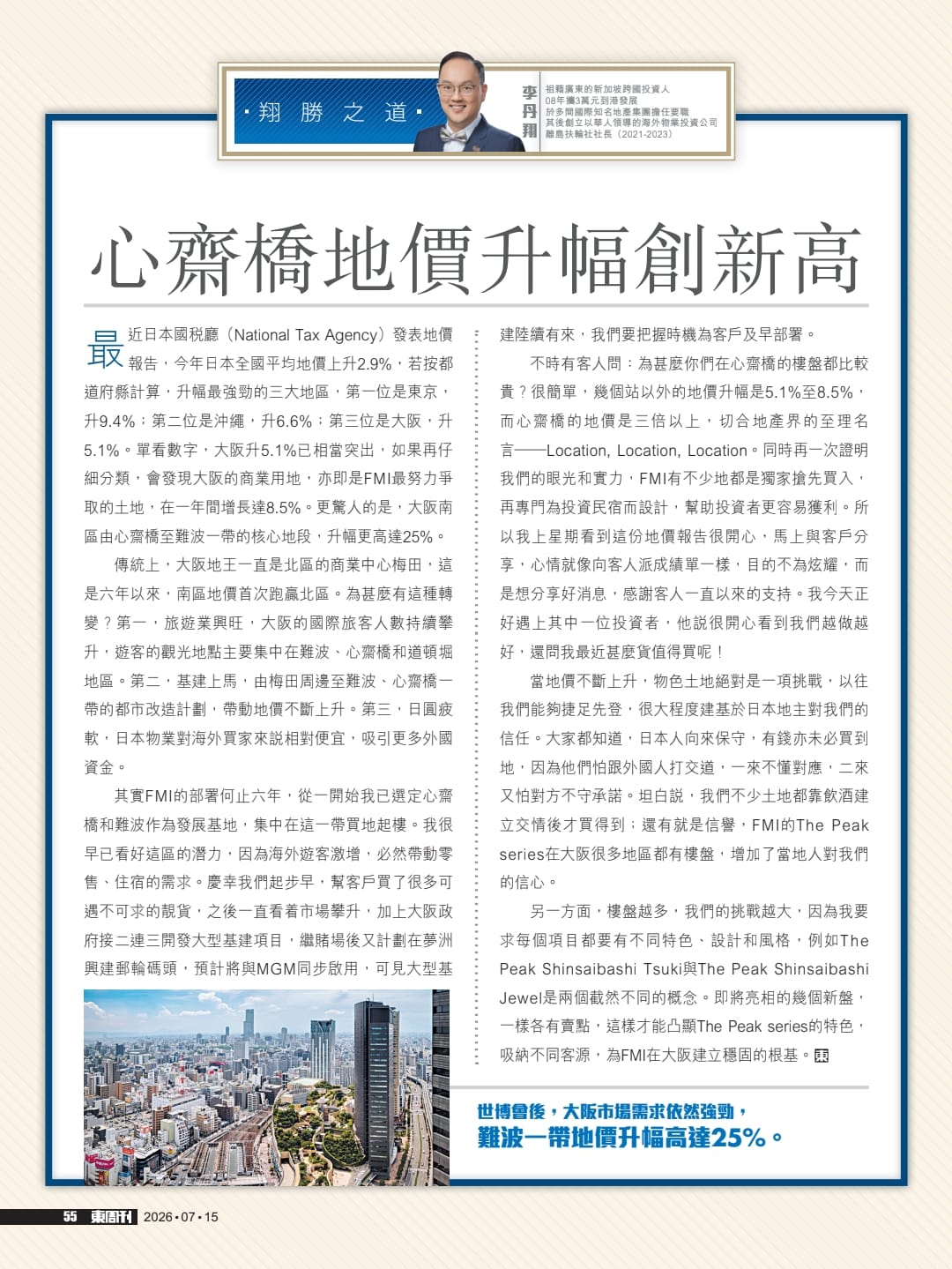
The Japan National Tax Agency recently released its annual land price report, revealing a 2.9% average increase across the country. Breaking it down by prefecture, the top three growth leaders were Tokyo (+9.4%), Okinawa (+6.6%), and Osaka (+5.1%). While Osaka’s 5.1% rise is impressive in itself, a closer look at commercial land—the very segment FMI works hardest to secure—shows an 8.5% growth rate. Most staggering of all, the core southern Osaka districts spanning from Shinsaibashi to Namba have seen land values surge by an astounding 25%.
Traditionally, Osaka's "Land King" status has been held by the Umeda commercial hub in the north. This marks the first time in six years that land prices in the south have outperformed the north. Why this shift?
1. Tourism Boom: International visitor numbers in Osaka continue to soar, with tourist activities heavily concentrated in the Namba, Shinsaibashi, and Dotonbori corridors.
2. Infrastructure Development: Urban renewal projects connecting the Umeda area to Namba and Shinsaibashi have fueled steady price appreciation.
3. Weak Yen: The depreciated Yen makes Japanese property relatively affordable for foreign investors, attracting significant international capital.
FMI’s strategy dates back well beyond these last six years. From the outset, we identified Shinsaibashi and Namba as our primary base, concentrating our land acquisition and development efforts there. We foresaw the potential early: as international tourism surged, demand for retail and accommodation was bound to skyrocket. I am grateful that we started early, securing prime properties that are now nearly impossible to find. We have watched the market climb ever higher, and with the Osaka government launching a series of massive infrastructure projects—following the casino complex, they are planning a new cruise ship terminal on Yumeshima, set to open alongside the MGM resort—it is clear that more major developments are on the horizon. We must seize this window to deploy strategies for our clients early.
Clients often ask me, "Why are FMI’s properties in Shinsaibashi relatively expensive?" The answer is simple: while land prices elsewhere might see growth of 5.1% to 8.5%, land in Shinsaibashi has tripled in value. It validates the golden rule of real estate: Location, Location, Location. It also underscores our vision and capability. Much of the land FMI acquired was obtained exclusively and ahead of the curve, specifically designed for vacation rental investments to help our investors maximize their returns. I was thrilled to share this report with our clients last week; it felt like delivering a report card—not to show off, but to share the good news and thank them for their unwavering support. One of our investors even asked me just today, "What's worth buying next?" as they are delighted to see us continuing to thrive.
As land prices rise, scouting for new plots becomes an increasing challenge. Our ability to stay ahead of the game is largely built on the trust we have earned from Japanese landowners. As we know, Japanese owners are traditionally conservative; money alone doesn't guarantee a land purchase. They are often wary of dealing with foreigners due to language barriers and concerns over commitment. Honestly, we have secured many plots only after building rapport over drinks. Beyond that, it comes down to reputation. The presence of FMI’s "The Peak" series across various districts in Osaka has significantly bolstered the local community's confidence in us.
On the other hand, the more projects we build, the greater our challenge becomes. I demand that every project possess its own distinct character, design, and style. For instance, The Peak Shinsaibashi Tsuki and The Peak Shinsaibashi Jewel are built on entirely different concepts. The new developments we are about to unveil will each have their own unique selling points. This is the only way to accentuate the features of "The Peak" series, attract diverse guests, and cement a solid foundation for FMI in Osaka.
With demand in the Osaka market remaining robust post-Expo, land prices in the Shinsaibashi and Namba areas have surged by up to 25%.
Author
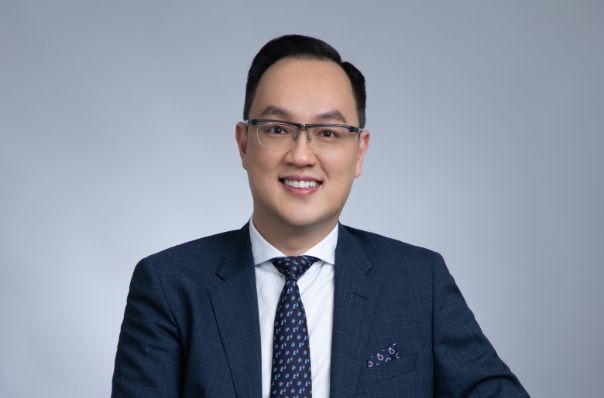
Amous Lee
The CEO and Partner of FMI Investment possesses over 24 years of extensive experience in international property investment. Throughout his 24-year career, he has been actively involved in project consultancy and marketing for multiple listed developers, successfully transacting and managing global properties valued at over USD 8 billion. In addition, he is a member of the Australian Institute of Quantity Surveyors (AIQS), as well as a member and former Secretary General of the Australian Institute of Building (AIB).
YOU MAY ALSO LIKE…